
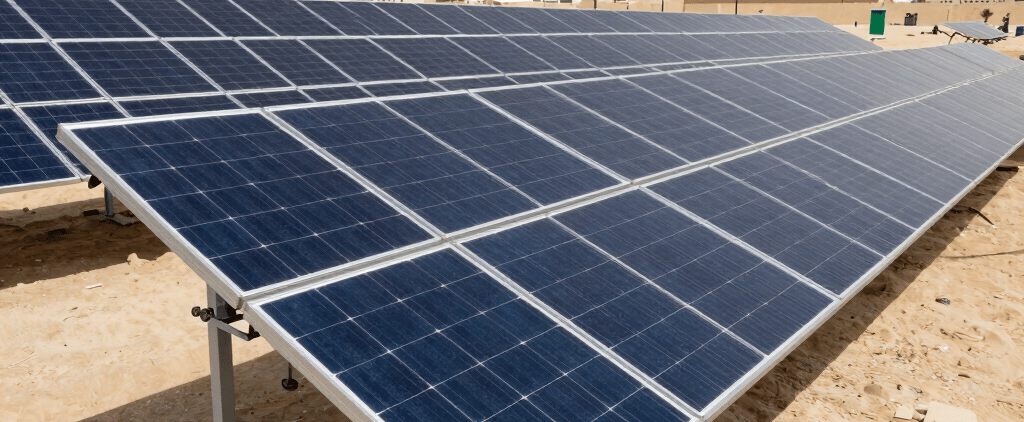
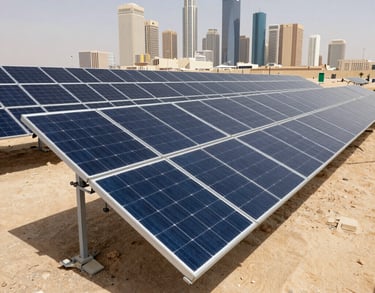
The sun has always been one of Saudi Arabia's most abundant natural resources. Now, for the first time in history, millions of Saudi homes and businesses can actually put it to work - generating clean electricity, slashing utility bills, and contributing to one of the most ambitious national energy transformations on the planet.
Whether you're considering solar panels for your villa in Riyadh, a commercial warehouse in Dammam, or a farm in Al-Jouf, this guide covers everything you need to make an informed decision in 2025.
Why Saudi Arabia Is One of the Best Places on Earth for Solar Energy
Let's start with the obvious: the sun shines hard in Saudi Arabia.
The Kingdom receives between 5.5 and 7.5 kilowatt-hours of solar energy per square meter, per day - among the highest levels recorded anywhere on Earth. For context, Germany - the country that pioneered the modern solar industry - averages around 3.0 kWh/m²/day. Saudi Arabia gets more than double that.
That extraordinary solar resource translates directly into financial returns. Solar panels in the Kingdom produce far more electricity per installed kilowatt than in Europe or North America, meaning systems pay for themselves faster and generate greater long-term savings.
But the solar boom in Saudi Arabia isn't just about geography. Several forces are converging at once:
Saudi Vision 2030 has set a target of generating 50% of the country's electricity from renewable energy by 2030. Solar is the primary vehicle for reaching that goal, and the government has mobilized billions of riyals in investment to make it happen - from the 1,500 MW Sudair Solar Power Plant northeast of Riyadh (one of the world's largest) to the 100% renewable energy commitments of NEOM and The Red Sea Project.
Electricity costs are rising. Saudi Arabia's heavily subsidized electricity era is gradually transitioning. As tariffs adjust and high-consumption households are charged more per kilowatt-hour, the financial case for solar strengthens year by year.
Prices have never been lower. The cost of solar panels has dropped over 90% since 2010 globally, and Saudi Arabia's growing installer market has brought genuine competition - meaning homeowners and businesses can now access high-quality systems at prices that were unthinkable a decade ago.
How Solar Panels Actually Work (In Plain Language)
You don't need a physics degree to understand the basics.
Solar panels are made of photovoltaic (PV) cells - typically silicon-based - that generate electricity when sunlight hits them. The panels produce direct current (DC) electricity, which flows through an inverter that converts it to alternating current (AC) - the type that powers your appliances, lights, and air conditioning.
In a standard grid-tied system (the most common setup in Saudi Arabia), your solar panels power your home during daylight hours. When production exceeds your consumption, surplus electricity flows to the SEC grid. When your panels aren't producing enough - at night, or on rare overcast days - you draw from the grid as normal.
Add a battery storage system, and you can store excess daytime solar energy to use at night, giving you greater independence from the grid and protection against power cuts.
The whole system is monitored through an app on your phone, showing you real-time production, consumption, and savings - twenty-four hours a day.
Types of Solar Panels Available in Saudi Arabia
Not all solar panels are equal. Here's what you'll encounter in the Saudi market:
Monocrystalline Panels
The premium choice. Made from a single crystal of silicon, these panels are the most efficient (20–23%), have the best heat performance, and come in a sleek all-black design. They're the top recommendation for Saudi Arabia's climate - especially in high-heat areas like Riyadh and the Eastern Province.
Polycrystalline Panels
A step down in efficiency (15–18%) but more affordable. Identifiable by their blue, speckled appearance. They work well in Saudi conditions but require more roof space for the same output as monocrystalline panels.
Thin-Film Panels
Flexible and lightweight, but significantly less efficient. Mostly used in industrial or specialty applications. Not the standard choice for residential or commercial rooftops.
What to Look For in Saudi Arabia's Climate
The critical spec to check is temperature coefficient - how much the panel's output drops as it gets hotter. Quality panels rated for high-temperature environments (look for a coefficient of -0.30%/°C or better) are essential in a country where summer roof temperatures can exceed 60°C.
Popular brands performing well in the Saudi market include Jinko Solar, LONGi, Canadian Solar, SunPower, Huawei (inverters), and SMA.
How Much Does a Solar System Cost in Saudi Arabia?
One of the most common questions - and one with a real, useful answer.
As of 2025, fully installed residential solar system prices in Saudi Arabia look roughly like this:
System SizeTypical Use CaseEstimated Cost (SAR)5 kWSmall apartment or low-consumption home15,000 – 25,00010 kWAverage family villa28,000 – 42,00015 kWLarge villa or high-consumption home40,000 – 60,00020 kWVery large villa or small commercial55,000 – 85,000
Prices include panels, inverter, mounting, wiring, and grid connection fees. Battery storage adds SAR 15,000–30,000 depending on capacity.
These are installed prices from licensed contractors. Quotes that come in significantly below these ranges should raise questions about component quality or hidden costs.
What's the Return on Investment?
For a typical Saudi family consuming 2,000 kWh/month, a 10–12 kW solar system can:
Reduce monthly electricity bills by 60–100% during daylight months
Generate 18,000–22,000 kWh of electricity per year
Pay back the installation cost in 5–8 years
Deliver 17–20 years of near-free electricity after payback
The ROI improves further for households on upper consumption tiers - where SEC charges higher per-kWh rates - since solar offsets the most expensive portion of your electricity bill first.
Solar Energy in Saudi Arabia's Major Cities
Saudi Arabia is a large country with genuinely different conditions from region to region. Here's what to know if you're in one of the major cities.
Riyadh
The capital city is a solar powerhouse. Over 3,000 sunshine hours per year, minimal humidity, and Saudi Arabia's largest villa market make Riyadh one of the most active solar cities in the Kingdom. The main maintenance consideration is dust - Riyadh's desert environment means panels should be cleaned at least monthly, and many homeowners invest in automated cleaning systems. A 10 kW system here produces approximately 18,000–20,000 kWh annually.
Jeddah
Saudi Arabia's commercial capital on the Red Sea coast has excellent solar resources but comes with a coastal twist: salt-laden humidity accelerates soiling on panels and can corrode standard mounting hardware. Specify marine-grade, corrosion-resistant mounting systems for Jeddah installations and plan for more frequent cleaning (every 2–3 weeks). Despite this, Jeddah's strong sun means solar is fully worthwhile - a 10 kW system produces approximately 16,000–18,000 kWh per year.
Dammam & the Eastern Province
The oil and gas heartland is increasingly embracing solar - not just for the environment, but for hard economic reasons. Industrial facilities, warehouses, and commercial properties across Dammam, Khobar, Dhahran, and Jubail are adopting solar to cut energy costs and meet corporate sustainability mandates. Residential solar in the region is also growing fast. As with Jeddah, coastal proximity makes corrosion-resistant hardware important.
Tabuk
Tabuk deserves special mention because it sits at the epicenter of Saudi Arabia's renewable energy ambition. The Tabuk region is home to NEOM - the futuristic megacity designed to run entirely on renewable energy - and hosts some of the highest solar irradiance readings in the entire Kingdom. Residential solar in Tabuk city is growing, and the proximity to major renewable projects means a growing pool of qualified installers.
Abha & the Asir Region
A pleasant surprise for solar skeptics: Abha's high altitude (~2,200m above sea level) keeps temperatures significantly cooler than the lowlands, and solar panels actually perform better in cooler temperatures. While the Asir region sees more cloud cover than the interior (and Arabia's highest rainfall), solar energy is still economically viable here, and the cooler operating conditions meaningfully boost panel efficiency relative to peak-heat cities.
Medina, Mecca & Taif
All three cities enjoy strong solar resources and are seeing growing residential and commercial adoption. Mecca and Medina, with their large hotel and hospitality sectors, are particularly suited to commercial rooftop and solar carport installations. Taif's elevation, like Abha, offers the dual benefit of good sun and cooler temperatures.
Hail, Al-Jouf & Northern Regions
The northern regions of Saudi Arabia are increasingly on the renewable energy map. Al-Jouf, famous for its olive farms, is being explored for large-scale agrivoltaic installations - where solar panels and crops share the same land. Hail's flat terrain and excellent irradiance make it ideal for both ground-mounted systems and future utility-scale development.
The Installation Process: What to Expect
Going solar in Saudi Arabia is a well-defined process. Here's what it looks like from start to finish:
1. Initial consultation and site assessment
A licensed installer visits your property to assess your roof (or ground space), measure shading, review your electricity bills, and evaluate your electrical panel. This is the foundation of your system design.
2. System design and proposal
The installer designs a system sized to your consumption and goals, specifying the number and type of panels, inverter, and any battery storage. You receive a written quote with itemized costs.
3. Permit application
Your installer handles permit applications with your local municipality and the Saudi Electricity Company (SEC) for grid connection. This step can take 2–8 weeks depending on your region.
4. Installation
Physical installation - mounting, wiring, inverter setup, and monitoring system - typically takes 1–3 days for a residential system.
5. Inspection and grid connection
A certified inspector approves the installation. SEC installs a bi-directional meter and activates your grid connection.
6. You start saving
From day one of activation, your panels are generating electricity and your bill starts dropping.
What About Permits and Regulations?
Solar installations in Saudi Arabia must comply with:
WERA (Water and Electricity Regulatory Authority) - the main sector regulator for energy in Saudi Arabia
SEC (Saudi Electricity Company) - handles grid connection applications and meter installation
REPDO (Renewable Energy Project Development Office) - governs the national renewable energy program
Saudi Building Code (SBC) - structural and electrical compliance standards
The RAAED self-generation program allows eligible customers to connect solar systems to the grid and potentially earn credits for surplus generation (net metering). Your installer should be familiar with current RAAED requirements and handle the application process on your behalf.
One firm rule: never hire an unlicensed contractor. Verify any installer's WERA/ECRA contractor license and SEC approval before signing anything. Unlicensed work can void warranties, fail inspections, and leave you liable for non-compliant installations.
Maintenance: Keeping Your System at Peak Performance
Solar panels are one of the most low-maintenance investments you can make - but in Saudi Arabia, one thing demands regular attention: dust.
Studies conducted in Saudi Arabia show that accumulated dust can reduce panel output by 15–40% within just a few weeks. The practical upshot:
Monthly cleaning is the minimum standard in most Saudi cities
Bi-weekly cleaning is recommended in dusty or desert-adjacent areas
After every sandstorm, clean panels before continuing operation
Use soft, low-mineral water and a soft brush - clean in the early morning or evening when panels are cool
Consider automated robotic cleaning systems for larger arrays
Beyond cleaning, your system needs minimal attention. An annual professional inspection of wiring connections, mounting hardware, and inverter performance is recommended. Modern inverters are largely maintenance-free and have a lifespan of 10–15 years.
Battery Storage: Should You Add It?
Battery storage is the upgrade that transforms a good solar system into a great one.
The case for batteries:
Use solar power at night, not just during the day
Protection from grid outages (critical in some remote areas)
Greater independence from rising utility tariffs
Optimise consumption of your own generated electricity
The honest trade-off:
Batteries add SAR 15,000–30,000 to your upfront cost and extend the payback period. If grid reliability in your area is good and your priority is purely financial ROI, batteries may not be necessary. If energy independence, backup power, or nighttime solar use matters to you, they're worth it.
The best battery technology for Saudi Arabia's heat is lithium iron phosphate (LiFePO4) - safer, more heat-tolerant, and longer-lasting than older lithium-ion or lead-acid options. Top choices in the Saudi market include the Tesla Powerwall, BYD Battery-Box, and Huawei LUNA.
Solar Energy and Saudi Arabia's Future
What's happening in Saudi Arabia's solar industry right now is genuinely extraordinary.
The Sudair Solar Power Plant (1,500 MW) - one of the world's largest solar facilities - is producing electricity for over 185,000 Saudi homes. NEOM's Oxagon is being built as the world's largest floating clean-industrial complex, powered entirely by renewables. The Red Sea Project will run its luxury resorts entirely on solar and wind. KAUST in Thuwal is producing world-leading research in next-generation solar cell technology, solar desalination, and agrivoltaics.
This isn't just government infrastructure. It's a full-society transition. And residential solar is a key part of it - each rooftop system is a small piece of the Kingdom's energy independence puzzle.
The Saudi Green Initiative, launched in 2021, set an ambition to avoid 278 million tonnes of carbon emissions annually. Solar energy - at every scale, from utility farms to rooftop panels - is the engine of that ambition.
How to Choose a Solar Company in Saudi Arabia
The solar market in Saudi Arabia is competitive and growing fast. That's mostly good news - more competition means better prices and service. But it also means there are less-than-reputable operators in the mix.
What to look for:
Valid WERA/ECRA license and SEC approval ✓
Transparent, itemized written quote ✓
Workmanship warranty of at least 5 years ✓
Quality equipment brands with local warranty support ✓
Clear post-installation support process ✓
Real references and portfolio of completed projects ✓
Red flags to avoid:
No verifiable physical address
Pressure to sign or pay immediately
Vague or verbal-only pricing
Upfront payment of the full amount demanded
Unable or unwilling to show licensing documents
Always get at least 3 quotes from licensed installers and compare them like-for-like: system size, panel and inverter brands, estimated annual production, warranty terms, and total cost.
Is Solar Right for You? A Quick Checklist
Ask yourself these questions:
✅ Do you own your home or commercial property?
✅ Is your roof in good condition and reasonably unshaded?
✅ Is your monthly SEC bill above SAR 500–600? (Higher consumption = faster ROI)
✅ Are you planning to stay in the property for 5+ years?
✅ Do you run high-consumption appliances like central A/C, a pool, or a water pump?
If you answered yes to most of these, solar panels in Saudi Arabia will almost certainly make strong financial sense for you - and the sooner you act, the sooner you start benefiting.
Final Thoughts
Saudi Arabia is not just adapting to the global solar revolution - it is helping to define it. With world-record solar irradiance, a government fully committed to the energy transition, falling system costs, and a mature installer market, there has never been a better time for Saudi homeowners and businesses to go solar.
The sun has been shining on the Arabian Peninsula for millions of years. In 2025, it's finally working for you.